Sapa Off the Beaten Path: 4 Secret Trekking Trails
Every travel blog about Sapa off the beaten path eventually sends you to Cat Cat Village or the lower Muong Hoa Valley. Both are beautiful. Neither is off the beaten path. The real Sapa off the beaten path starts where the navigation apps stop working and the trail markers disappear.
These four trails are genuinely remote. Two require a xe om (motorbike taxi) to reach the starting point. One has no mobile signal for the entire duration. None of them appear on the standard Sapa tourist circuit. That’s the point.
Quick Info
| Trail | Distance | Starting point | Guide needed? | Signal? |
|---|---|---|---|---|
| Sa Seng Village | 6km from road | xe om from Sapa | No (Recommended) | Patchy |
| Hau Thao Ridge | 4km from valley | Walking from Lao Chai | No | Patchy |
| Ban Ho Hot Springs | 24km from Sapa | xe om or private transfer | No | None |
| Thanh Kim Valley | 15km | xe om + walking | Yes | None |
Why “Off the Beaten Path” in Sapa Means Something Specific

The term Sapa off the beaten path has been diluted by years of travel content. Cat Cat Village, Y Linh Ho, and the lower sections of Lao Chai are described as “hidden” and “authentic” on dozens of sites. However, all three are well-marked, entry-fee charging, and heavily trafficked by morning tour groups.
The four trails in this guide are different in a specific way: they require either vehicle access to a remote starting point, navigation confidence in unmarked terrain, or the ability to manage without phone signal for several hours. Additionally, none of them have souvenir stalls at the trailhead.
That said, “remote” doesn’t mean “dangerous.” The trails are well-established by local use even if they’re not on tourist maps. The risk is getting lost, not anything more serious. Accordingly, offline navigation preparation before departure is the most important thing you can do.
Trail 1: Sa Seng Village — The Red Dao Cardamom Route
Sa Seng is the most atmospheric Sapa off the beaten path trail on this list. The village sits at higher elevation than the Muong Hoa Valley, reached by a road that climbs through wild cardamom plantations. The smell begins about 2km before the village: warm, spiced, and unmistakably specific to this altitude.
The Red Dao women of Sa Seng wear distinctive bright red headdresses and produce hand-embroidered textiles using natural indigo dye. Unlike Lao Chai or Ta Van, the Sa Seng women aren’t accustomed to performing their crafts for visitors. They’re working. That contrast is immediate.
Getting there: xe om from Sapa center, approximately 15km. Cost: 50,000-100,000 VND. Ask for Sa Seng Village specifically. Some xe om drivers won’t know it. Find one who does before agreeing on the fare.
The walk: From the village entry point, a 6km loop through cardamom fields, traditional Red Dao houses, and elevated viewpoints back to the road takes about 3 hours. The path is largely clear but download ExoTrails offline GPS before leaving Sapa town.
Guided option: This private trek through the Hoang Lien highland area routes through less-visited Red Dao territory with a knowledgeable local guide who speaks English and understands the community context.
Trail 2: Hau Thao Ridge — The Panoramic Viewpoint Above the Valley

Hau Thao is the most accessible Sapa off the beaten path destination on this list. Most trekkers walk below it on the Muong Hoa Valley floor and never look up. The village sits on a ridge above Lao Chai, reachable by a steep 45-minute climb from the main valley path.
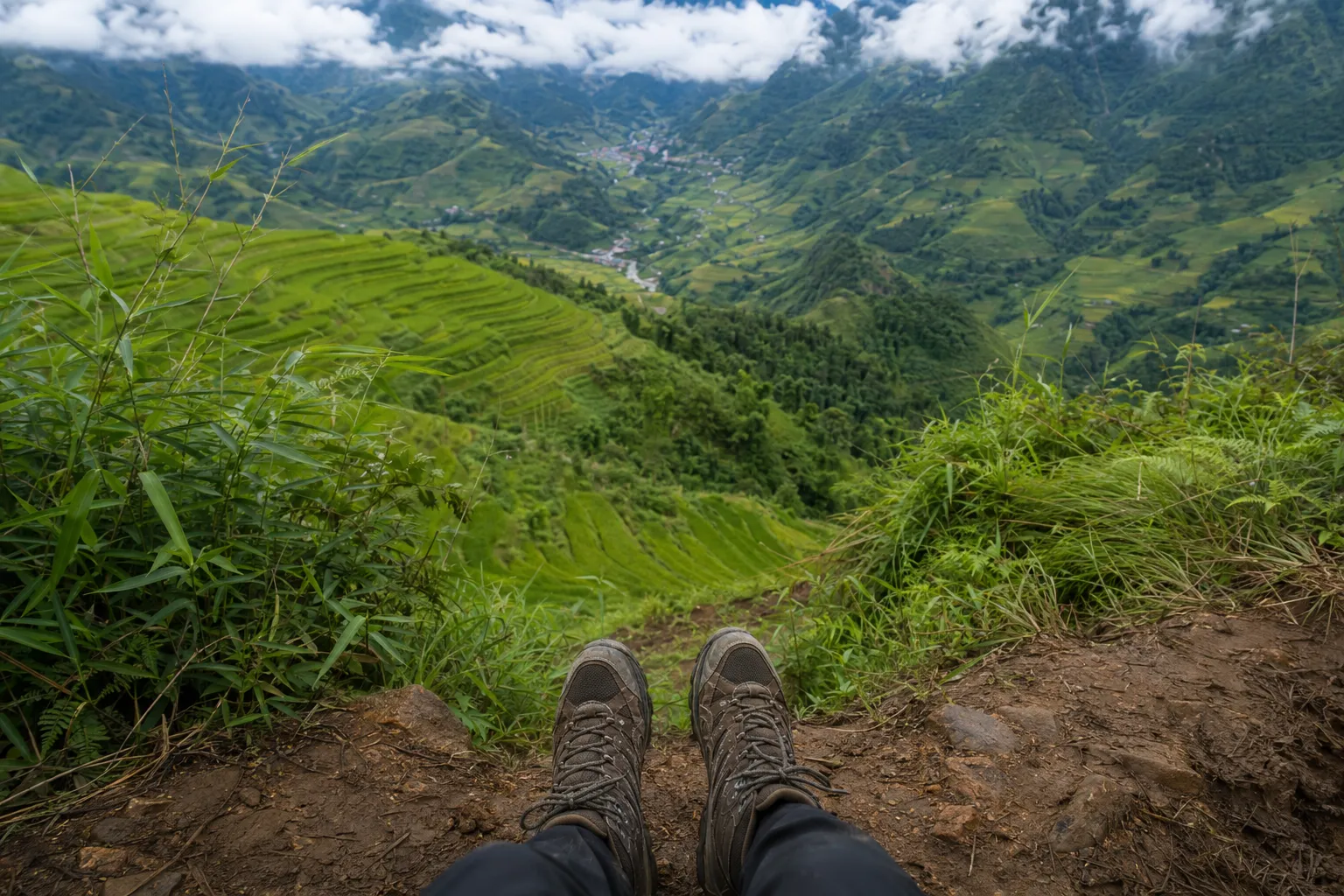
The view from Hau Thao is the reason to go. The entire Muong Hoa Valley stretches below, from Y Linh Ho all the way to Ta Van, in a single unobstructed frame. In golden harvest season, this viewpoint delivers the most complete aerial perspective of the terraces available without a drone.
Getting there: Self-guided from the main Muong Hoa Valley path. At Lao Chai, instead of continuing to Ta Van, turn uphill on the track that climbs the ridge. The path is steep, unmarked, and takes 45 minutes. There’s a small Black Hmong village at the top.
Why it stays quiet: The climb is steep and the reward isn’t obvious from below. Most tour groups stay on the flat valley trail. That’s why you go up.
Cloud hunting opportunity: In November, Hau Thao ridge is one of the best positions for the cloud hunting phenomenon. The valley fills with fog while the ridge stays clear. The optimal window is 6am to 8am. Plan an early start for this specific experience.

Trail 3: Ban Ho Village — Hot Springs at the End of the Road
Ban Ho is the most remote Sapa off the beaten path destination accessible as a day trip. The Tay ethnic minority village sits 24km from Sapa on the banks of the Muong Hoa river, reached by a road that descends through jungle and bamboo forest before arriving at a river valley.
The village itself is built on traditional wooden stilt houses raised above the valley floor. The Tay are distinct from the Hmong and Red Dao communities in language, architecture, and food culture. Visiting Ban Ho is genuinely different from any experience on the main Sapa tourist circuit.
The hot springs are a 15-minute walk from the village center, natural, free, and genuinely restorative. Specifically, after a day of steep highland trekking, a soak in the mineral springs is one of the best endings available in the Sapa area. The water temperature is warm, not scalding, and the setting, surrounded by bamboo and mountain forest, is completely quiet.
Getting there: xe om from Sapa, approximately 24km. Cost: 100,000-150,000 VND. Allow 45-60 minutes each way. The road descends significantly. Some drivers charge more for the return climb. Agree on the round-trip price before departing.
What to bring: Cash (200,000-300,000 VND minimum), water, lunch from Sapa town, and a towel for the springs. There are no shops at Ban Ho.
Trail 4: Thanh Kim Valley — The Deep Forest Trek

Thanh Kim is the most genuinely challenging Sapa off the beaten path trail on this list. The valley sits deeper into the mountain range than the other three trails, reached by xe om and then a 15km forest walk through primary bamboo and mountain terrain.
The trail has no markers, no signal throughout, and no facilities. It passes through territory where the landscape changes from terraced farmland to dense highland forest within the first hour. Furthermore, the path requires a local guide with actual knowledge of the route, not a general trekking guide from Sapa town.
Getting there: xe om to the trailhead, approximately 20km from Sapa. The walk itself is 15km round trip, 5-6 hours. Plan for a full day.
Guide requirement: Thanh Kim is not a self-guided route. The trail junctions are indistinguishable without local knowledge. This private guided trek can be arranged to cover the Thanh Kim area with a guide from the region. Alternatively, ask at Topas Ecolodge directly. They organize custom highland treks and have relationships with local guides who know this route.
What makes it worth it: Thanh Kim is the closest you’ll get to uninhabited highland wilderness within a day trip of Sapa. The forest sections, particularly the bamboo groves in the mid-valley, are unlike anything on the main tourist circuit.
Essential Preparation for Sapa Off the Beaten Path Trails
Download ExoTrails before leaving Sapa town. This offline GPS platform has the most accurate trail data for the remote Sapa area. None of these four trails are accurately represented on standard navigation apps. Download the Lao Cai province data set before you leave town, because signal drops to nothing on all four routes.
Carry enough cash for the full day. ATMs don’t exist beyond Sapa town. A full day on any of these trails requires cash for xe om transport (100,000-200,000 VND), lunch if available at a village, and any incidental costs. Bring 500,000 VND minimum.
Book the right base. Remote trail access is significantly easier from a valley or park-edge base than from Sapa town center. Topas Ecolodge is closest to the Sa Seng and Thanh Kim starting points. Eco Hills Homestay in Ta Van is the best base for Ban Ho day trips. For the full accommodation breakdown, see Where to Stay in Sapa: Best Hotels and Homestays 2026.
Start early. All four trails work best before 9am when temperatures are cooler and the valley mist creates better photography conditions. Additionally, xe om drivers are easier to find and negotiate with before the morning tour group rush begins around 9am.
Activate a Vietnam eSIM. Signal drops completely on Ban Ho and Thanh Kim routes. Download offline maps and ExoTrails before leaving town. Activate a Vietnam eSIM before your flight for reliable connectivity in Sapa town itself, even if the trails require full offline mode.
FAQ
Is Sapa off the beaten path still accessible without a guide? Sa Seng and Hau Thao are manageable self-guided with offline maps and xe om access. Ban Ho is self-guided by vehicle to the village. Thanh Kim requires a guide. For the full guided vs self-guided breakdown, see Sapa Trekking Guide 2026: Guided vs Self-Guided Routes.
What is the most remote trail near Sapa? Thanh Kim Valley. It has no signal, no markers, and requires a guide with genuine local knowledge. However, Ban Ho is the most rewarding for the effort, combining a remote village culture with natural hot springs.
Are these trails safe? Yes, with preparation. The risk on all four is getting lost without offline navigation, not anything more serious. Download ExoTrails, carry cash, and tell your accommodation where you’re going before you leave.
How do I find a xe om driver for remote routes? Ask at your hotel or homestay. Most can arrange a reliable driver for a set price. Alternatively, walk to the Sapa market area in the morning and negotiate directly. Always agree on the round-trip price including wait time before departing.
For everything beyond the trails, Sapa Valley Travel Guide: How to Slow-Travel Vietnam’s Highlands covers where to stay, how to get there, and how to structure your time in the valley.
Done with the trails? 10 Best Things to Do in Sapa: What’s Actually Worth It has the rest of your itinerary covered.